Construction Project Benchmarking: How to Validate Schedule Durations Against Industry Standards
Learn how to benchmark construction schedule durations against industry data. Covers methods, data sources, duration ranges by project type, and EOT claims.
A contractor submits a 14-month programme for a 20-storey commercial office tower. The client’s project manager has seen similar buildings take 22 to 28 months, but doesn’t have the data to challenge the submission formally. The programme gets approved, and nine months later the project is already six months behind. By the time the dispute lands, the cost overrun dwarfs the original estimate.
This scenario plays out across the industry. Bent Flyvbjerg’s research on megaprojects shows that 91.5% of projects go over budget, over programme, or both. Only 0.5% deliver on budget, on time, and on benefits. Benchmarking schedule durations against known industry ranges is one of the few tools a client-side PM has to catch unrealistic programmes before they become expensive problems, and it sits alongside a complete schedule analysis as part of any robust programme review.
Why Most Construction Programmes Are Unrealistic
Optimism bias infects construction programmes from the first sketch. Contractors under pressure to win tenders produce programmes that show what the client wants to see, not what the work actually requires. The commercial incentive is obvious: a shorter programme looks more attractive at tender, and the contractor banks on claiming extensions of time later.
Flyvbjerg’s data makes the scale of the problem clear. Across 258 transport infrastructure projects (Flyvbjerg, Holm and Buhl, Journal of the American Planning Association, 2002), nine out of ten exceeded their original cost estimate. Building projects fare no better. The Auditor General for Scotland’s 2004 report on the Holyrood Parliament Building set out a final outturn cost of around £431 million against an initial cost estimate of approximately £40 million when construction began, and a project that opened three years later than originally programmed. California’s High-Speed Rail project has seen its projected cost climb to several times the original estimate. These aren’t outliers; they’re the statistical norm.
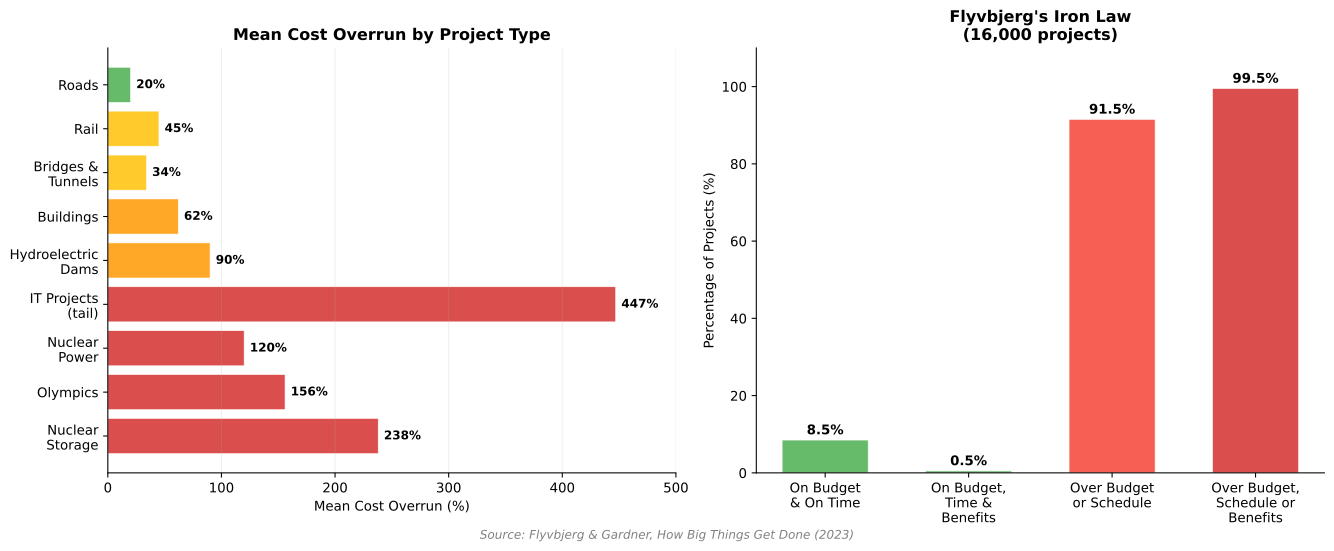 Mean cost overrun by project type (left) plotted against the Iron Law of Megaprojects headlines (right): 91.5% over budget, programme, or both, with only 0.5% delivering on all three measures (Flyvbjerg, How Big Things Get Done). The benchmark range you compare a contractor’s programme against sits inside this distribution, not outside it.
When the vast majority of major projects overrun, a submitted programme that reflects best-case conditions isn’t optimistic; it’s statistically improbable. A client who approves it without benchmarking is accepting a plan that history says will fail.
The consequences compound. Unrealistic programmes distort cash flow forecasts, misallocate resources, and create a baseline that guarantees extension of time claims. Once approved, that baseline programme becomes the yardstick for measuring delay. A baseline that was never achievable from the start gives the contractor a low bar to beat, and the client a high bar to defend.
What to Benchmark
Benchmarking isn’t a single number comparison. It operates at several levels of detail, each serving a different purpose during programme review.
Overall project duration by building type
The first check is the simplest: does the total programme duration fall within known ranges for this project type and scale? A 30-storey residential tower in a major Australian city typically takes 24 to 36 months. If a contractor proposes 16 months, the gap warrants immediate scrutiny.
| Project Type | Typical Duration Range | Key Variables |
|---|---|---|
| Low-rise residential (up to 4 storeys) | 10-16 months | Site access, finishes complexity |
| Mid-rise residential (5-12 storeys) | 14-24 months | Basement depth, podium design |
| High-rise residential (13+ storeys) | 20-36 months | Core cycle speed, façade system |
| Commercial office (mid-rise) | 18-30 months | Fitout scope, tenant requirements |
| Commercial office (high-rise) | 24-40 months | Structural system, core count |
| Hospital | 36-60 months | Commissioning, medical equipment |
| School | 14-22 months | Phasing, holiday constraints |
| Road infrastructure (per 10km) | 12-24 months | Terrain, utilities, approvals |
Table 1: Indicative project duration ranges by building type (Australian market, 2020-2025 data)
Key milestone durations
Overall duration tells you whether the programme is broadly plausible. Milestone durations tell you whether the sequence is realistic. The critical path runs through milestones, and if those milestones are compressed, the logic is suspect.
Check the duration from contract award to practical completion, but also check intermediate points. How long from commencement to structural completion? How long from structural completion to envelope close? How long from envelope close to practical completion? Each of these phases has a narrower range of plausible durations than the project as a whole, making deviations easier to spot.
Activity-level durations and production rates
The most granular level of benchmarking targets individual activities and their production rates. A concrete pour cycle of four days per floor for a typical high-rise is aggressive but achievable. Two days per floor, on a conventional build, is fantasy. Pair the duration check with the critical path method as it applies to construction, so you’re testing both the activity duration and its position in the network. The DCMA 14-Point Assessment flags activities with durations exceeding 44 working days as a quality risk, but short durations deserve equal attention if they imply impossible production rates.
Benchmarking production rates requires data: cubic metres of concrete per crew per day, linear metres of ductwork per shift, square metres of tiling per installer per week. This is the level where your own project records become the most valuable benchmarking source.
Schedule density
Schedule density measures how much detail a programme contains relative to its remaining duration. A programme with 800 activities spread across a 24-month project has lower density than one with 1,400 activities across the same period. Low density doesn’t make a programme wrong, but it makes benchmarking harder and obscures the critical path. The GAO Schedule Assessment Guide (December 2015) recommends that near-term work (zero to three months out) be planned at a level where activity durations don’t exceed the reporting period.
Sources of Benchmark Data
No single source covers all project types and regions. Effective benchmarking draws on multiple data sources and cross-references between them.
Commercial databases
RS Means provides construction cost and duration data for the North American market, with unit-level production rates useful for activity-level benchmarking. The Building Cost Information Service (BCIS), operated by the Royal Institution of Chartered Surveyors, offers duration and cost indices for the UK market; these are the closest analogue for Australian practitioners working in Commonwealth contracting systems. The Turner Building Cost Index tracks cost trends quarterly and provides programme duration benchmarks for commercial construction in the United States.
These databases have limitations. They’re region-specific, they lag current market conditions, and they aggregate across a wide range of project complexities. Use them as starting points, not conclusions.
Government and institutional databases
Australian state government infrastructure agencies publish project delivery reports with actual programme performance data. Transport for NSW, Major Road Projects Victoria, and the Queensland Department of Transport and Main Roads all release post-completion reviews that contain actual versus planned programme comparisons. These are free, credible, and specific to local conditions.
The United States Government Accountability Office published the Schedule Assessment Guide in December 2015, which includes benchmarking guidance and best-practice criteria for schedule quality. While US-specific, the methodology translates directly.
Insurance and surety sources
Surety companies maintain proprietary databases of project performance because they bear the financial risk of programme failure. Their data tends to be conservative and well-validated. While not publicly available, surety benchmarks inform the expectations of lenders and principal agents who rely on surety assessments.
DCMA and GAO benchmarks
The Defense Contract Management Agency 14-Point Assessment provides a schedule-quality baseline rather than duration benchmarks per se, but several of its 14 checks function as proxy benchmarks. The check on activities with durations exceeding 44 working days, for instance, implicitly benchmarks activity-level planning density. The GAO Schedule Assessment Guide’s criteria for valid schedules (sections 3 through 7) set expectations that can be benchmarked across programmes.
Build your own database
The most reliable benchmarking data comes from your own completed projects. For client-side PMs who review contractor programmes regularly, maintaining a database of actual milestone dates, activity durations, and production rates across past projects creates a bespoke benchmarking tool that no commercial database can match.
Callout: Start with a simple spreadsheet. Record contract type, project value, building height, structural system, region, actual commencement date, structural completion date, practical completion date, and the contractor’s original programme duration. After five projects, patterns emerge. After 20, you have a benchmarking tool that carries more weight in a dispute than any published reference.
Figure 2: Benchmark data sources ranked by reliability
Indicative Duration Benchmarks by Project Type
The table below synthesises indicative ranges from Australian and international sources. These are not prescriptive. They represent the bulk of observed projects, with the extreme outliers at the top and bottom excluded.
Residential projects
Low-rise residential buildings (one to four storeys) in Australian metropolitan markets typically deliver in 10 to 16 months from commencement to practical completion. Mid-rise buildings (five to 12 storeys) extend to 14 to 24 months, with the range driven heavily by basement complexity and the extent of common-area finishes. High-rise towers (13 storeys and above) fall in the 20 to 36 month range, where the primary determinant is the structural cycle speed and the façade installation programme.
Residential staged developments add another dimension: construction of multiple buildings in sequence can extend the overall development programme to 36 to 60 months, but individual stages should still fall within the ranges above.
Commercial office projects
Mid-rise commercial office buildings (up to 15 storeys) typically deliver in 18 to 30 months. High-rise commercial towers (15 storeys and above) range from 24 to 40 months. The wide range reflects the variability in fitout scope: a base-building delivery with tenant fitout to follow will hit the lower end, while a fully fitted finish pushes toward the upper bound.
Compared to residential, commercial projects carry longer commissioning programmes for mechanical, electrical, and fire services. A typical commercial project’s final three to four months are dominated by services commissioning and certification, a phase that contractors routinely underestimate.
Industrial and infrastructure projects
Industrial facilities vary too widely by process type for generic benchmarking; a cold storage warehouse and a petrochemical plant bear no resemblance in duration. Road infrastructure presents a more standardised basis: as a rough guide, 12 to 24 months per 10 kilometres of new road construction, depending on terrain, utility relocation, and environmental approval conditions.
| Project Type | Low Estimate | Mid Range | High Estimate | Primary Risk |
|---|---|---|---|---|
| Residential low-rise (per building) | 10 months | 13 months | 16 months | Weather delays |
| Residential high-rise (per building) | 20 months | 28 months | 36 months | Façade lead time |
| Commercial office mid-rise | 18 months | 24 months | 30 months | Services commissioning |
| Commercial office high-rise | 24 months | 32 months | 40 months | Core cycle speed |
| Hospital | 36 months | 48 months | 60 months | Commissioning complexity |
| Road infrastructure (per 10km) | 12 months | 18 months | 24 months | Approvals and utilities |
Table 2: Indicative duration benchmarks by project type with risk drivers
How to Benchmark a Contractor’s Programme
Benchmarking a contractor’s programme is a structured comparison, not a gut check. Follow these steps. They sit naturally inside the wider workflow described in our guide on how to review a contractor programme.
Step 1 needs the activity list with durations. If the programme arrived as an .xer or .mpp and you have no licence to open it, the free schedule viewer exports every activity’s durations, dates and logic to Excel.
Figure 1: Five-step benchmarking process
Step one: Gather the data. Collect the contractor’s submitted programme, the contract conditions, the project specifications, and any geotechnical or environmental reports that affect constructability. You can’t benchmark without knowing the constraints the programme must satisfy.
Step two: Compare overall duration. Check whether the total programme falls within the indicative range for the project type and scale. If it does, move to the next step. If it doesn’t, flag it immediately and document the gap.
Step three: Compare milestone durations. Break the programme into its major phases: earthworks and substructure, structure, envelope, services, fitout, and commissioning. Compare each phase duration against your benchmarks. A programme can fall within the overall range but still contain compressed phases that are only achievable if other phases are unrealistically long.
Step four: Compare activity-level durations and production rates. Identify the 10 to 15 critical-path activities and check their durations against known production-rate data. A five-day concrete pour for a 1,200-square-metre floor plate, at the production rates your records show achievable, should raise a query.
Step five: Identify and document outliers. Every deviation from the benchmark isn’t necessarily wrong. The contractor may have access to a different methodology, more resources, or prefabrication options that justify a shorter duration. But every deviation must be identified and either accepted with a documented reason, or challenged.
Callout: We recommend documenting every benchmarking query as a formal RFI or programme review comment. Verbal discussions evaporate. A written query creates a record that the contractor had notice of the concern and either revised the programme or accepted the risk.
Apply Benchmarking to EOT Claims and Disputes
Extension of time claims generate the most contentious application of schedule benchmarking. The contractor argues that delays were beyond their control; the principal argues the contractor should have foreseen and mitigated them. Benchmarking provides an evidentiary basis for both positions, and it dovetails with the wider methods used in EOT claim analysis when the dispute moves toward formal adjudication.
Challenge unrealistic as-planned programmes
A common problem in EOT disputes: the as-planned programme was never achievable. If the contractor’s baseline programme for a hospital project allocated 30 months when the benchmark range is 36 to 60 months, the programme was unrealistic from the start. The SCL Delay and Disruption Protocol (2nd Edition), paragraph 1.56, requires acceptance of the programme to constitute an acknowledgement that it represents a ‘reasonable, realistic and achievable depiction of the sequence and timing for carrying out the works’. A programme that falls well outside benchmark ranges fails this test.
When the as-planned programme is unrealistic, the delay analyst’s task becomes harder because the baseline itself doesn’t represent a fair benchmark for measuring excusable delay. Courts and tribunals have accepted evidence that the baseline programme was optimistic to the point of being unachievable, and have adjusted the analysis accordingly.
Demonstrate actual performance against industry norms
Benchmarking also works in the contractor’s favour. If actual productivity on a project fell within industry norms but the contractor still couldn’t meet the programme, that’s evidence the programme was at fault, not the contractor’s performance. AACE International’s RP 25R-03 (Estimating Lost Labor Productivity) provides methods for comparing actual productivity against expected norms, which can demonstrate that the contractor performed at a reasonable rate despite failing to meet an unreasonable programme.
The Empire State Building remains the counterexample that proves benchmarking is about sound planning, not pessimism. Built in around thirteen months, it came in under budget and ahead of programme. That wasn’t luck. It was meticulous coordination, standardised design, and a level of schedule density and resource loading that most modern programmes can’t match. The lesson isn’t that fast programmes are impossible; it’s that fast programmes require exceptional planning, not optimism.
| Metric | Empire State Building | Typical Comparable Modern Project |
|---|---|---|
| Construction duration | 13 months | 24-36 months |
| Budget performance | Under budget | Frequently over budget (Flyvbjerg, 91.5% of major projects overrun cost or programme or both) |
| Storeys erected per week | Up to 4.5 | 1-2 (typical) |
| Schedule density | Extremely high | Moderate |
Table 3: Empire State Building performance versus modern benchmarks
Limitations of Schedule Benchmarking
No benchmarking exercise replaces critical path analysis. Durations that fall within benchmark ranges can still produce an illogical sequence, resource conflicts, or missing logic ties. The programme is a network, not a collection of independent activities, and benchmarking individual durations doesn’t validate the network.
Every project is unique. The same 20-storey office building on a constrained CBD site with a three-level basement takes longer than one on a greenfield site with at-grade parking. Benchmarking adjusts for obvious variables, but it can’t account for every site-specific constraint. Regional variations matter too. A project in North Queensland carries wet-season risks that a Melbourne project doesn’t face; a Perth high-rise operates in a different labour market from Sydney.
Data currency is a persistent limitation. Commercial databases lag behind current conditions. A recession that floods the market with available labour shortens programmes; a boom that stretches supply chains lengthens them. Always check the date of your benchmark data and consider whether market conditions have shifted.
Finally, benchmarking tells you what has happened, not what should happen. Most hospital projects take 48 months, but that doesn’t mean a 48-month programme is optimal; it means the industry typically delivers hospitals in that timeframe. Better planning, better coordination, and better technology can push durations below benchmark ranges. The Empire State Building proved that. But deviations below benchmark ranges should be justified, not assumed.
Records and Verification
Contemporaneous records underpin credible benchmarking analysis. Without them, you’re offering opinions rather than evidence.
The records that support benchmarking analysis include the approved baseline programme and all subsequent revisions, progress reports with actual start and finish dates for milestones and activities, site diaries recording weather events, industrial action, and access constraints, correspondence between the principal and contractor regarding programme expectations, and the contractor’s resource and production-rate submissions. Each of these creates a paper trail that ties the benchmarking comparison to documented project conditions.
For disputes, tribunals and courts give far more weight to benchmarking analysis supported by contemporaneous records than to expert opinion based on general experience alone. AACE RP 17R-97 (Cost Estimation) emphasises the importance of documented, verifiable data as the basis for any estimation or benchmarking exercise. The same principle applies to programme benchmarking: document your sources, state your assumptions, and preserve the underlying data.
Standards References
- AACE RP 25R-03: Estimating Lost Labor Productivity in Construction; provides methods for comparing actual productivity against expected industry norms.
- AACE RP 17R-97: Cost Estimation; principles of documented, verifiable estimation applicable to programme benchmarking.
- DCMA 14-Point Assessment: Schedule quality baseline; several points function as implicit benchmarks for planning density.
- GAO Schedule Assessment Guide (December 2015): Sections 3 through 7 cover schedule validity criteria; benchmarks for schedule quality and density.
- SCL Delay and Disruption Protocol (2nd Edition): Paragraph 1.56 (acceptance of programme as reasonable, realistic and achievable); paragraph 4.8(b) (recovery plans must be reasonable, realistic and achievable)
Close
Benchmarking doesn’t guarantee a realistic programme, but it catches the unrealistic ones. Compare submitted durations against known ranges for the project type. Flag every outlier. Demand justification for deviations. Document your findings. A 14-month programme for a building that typically takes 24 months isn’t ambitious; it’s a future dispute. The five minutes it takes to check against a benchmark table might save you five months of variation claims.